May 5th
In keeping with the tradition of other Astronaut and Space related celebrations, May 5th was selected for this significant date in history in 1961 when Astronaut Alan Bartlett Shepard Jr. became the First American in Space, aboard the Freedom 7 Space capsule. The brief suborbital flight, which lasted approximately 15 minutes and reached a height of 116 miles into the atmosphere, was a milestone achievement. This trailblazing example of heroic bravery and adventurous spirit is this essence of what National Astronaut Day is all about.
Why Do #WeBelieveInAstronauts? The incredible experience of traveling through space is something we all dream about at one time in our life. For a very select few, this dream became a reality. The path for every Astronaut is different, and Astronauts come from a diverse range of personal and professional backgrounds and include experiences such as: scientists, inventors, educators, engineers, trailblazers, innovators, executives, historians, authors, philanthropists, advocates and dreamers. The one thing they all have in common – They are leaders in their chosen fields, pioneers of space and seek to share their individual knowledge and lessons as an Astronaut to benefit us ALL.
Please join us as we celebrate these amazing individuals, their unique experiences, and ultimately, to help spread the message that… no matter what our journey in life we are ALL Astronauts. #WeBelieveInAstronauts
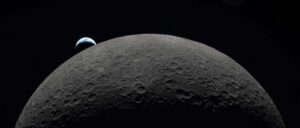
Photo Credit: Earthset captured through the Orion spacecraft window at 6:41 p.m. EDT, April 6, 2026, during the Artemis II crew’s flyby of the Moon. (Photo: NASA)
10th Annual National Astronaut Day Challenge
Spatial Perspective: Dream Bigger, Look Higher, Rise Above
We Believe in Astronauts. Not just the individuals who strap themselves to rockets and punch through the atmosphere — but in what they represent for every one of us: the audacity to know where you are, dare to imagine where you want to go, and then summon the courage to launch.
Sixty-five years ago, on May 5, 1961, Alan Shepard became the first American to reach space, becoming the first US Astronaut. His Freedom 7 capsule climbed 116 miles above the Earth in a flight lasting just fifteen minutes — but those fifteen minutes changed our relationship with perspective forever. For the first time, an American looked back at our world from above and saw it whole: connected, finite, and breathtakingly alive. That singular shift in vantage point — from standing on the Earth to looking back at it — is the very essence of what geographers and explorers call the spatial perspective.
The spatial perspective is fundamentally about understanding relationship and position. It asks: Where are you? What surrounds you? How are you connected to the larger systems, communities, and landscapes that shape your life? Geographer Waldo Tobler captured a foundational truth when he observed that everything is related to everything else — and that proximity, whether physical, social, or aspirational, defines those relationships. Astronauts experience this truth in the most visceral way possible. The moment a spacecraft clears the atmosphere, the boundaries that divide us on the ground dissolve. Oceans, borders, and mountain ranges become part of a single, seamless, living portrait. Astronauts frequently describe this as the Overview Effect — an almost overwhelming recognition of interconnectedness that permanently reshapes how they see themselves and humanity.
This is why #WeBelieveInAstronauts. They do not just travel to space — they come back changed, and they change us with them.
From Shepard’s pioneering arc in 1961, through the Apollo missions that put human footprints on the moon, through the Space Shuttle era and the construction of the International Space Station, to NASA’s current Artemis program — which is returning humans to lunar orbit and laying the groundwork for eventual missions to Mars — each chapter of human spaceflight has expanded our collective spatial perspective. Artemis is not simply a return to the Moon; it is a leap toward understanding our position in a far larger geography than any map has ever captured. It carries the first woman and first person of color toward the lunar surface, expanding not just who gets to hold that perspective, but who gets to dream it into being, and literally provided new perspective with new Earthrise images seen with detail on the Moon like never before.
The spatial perspective matters here on Earth just as profoundly as it does from orbit. When we understand where we are — truly understand our place within our neighborhoods, our regions, our ecosystems, and our economies — we gain the clarity to chart a course forward. As geospatial thinkers have long argued, knowing your location is never just about coordinates. It is about recognizing the connections around you: the people, resources, opportunities, and challenges woven into the fabric of where you stand. That knowledge is the launchpad for everything that comes next.
This is the challenge of National Astronaut Day 2026:
Dream Bigger — because every mission that seemed impossible once was imagined by someone who refused to accept the limits of the horizon they could see.
Look Higher — because a higher vantage point doesn’t just show you more; it shows you how everything below is connected in ways you couldn’t recognize from the ground.
Rise Above — not to escape the world, but to return to it with new eyes and the will to make it better.
Alan Shepard didn’t know exactly what he would find when Freedom 7 lifted off. The Artemis crews don’t know every challenge that awaits them on the path to the Moon and beyond. But they do what every great explorer, innovator, and dreamer has done throughout history: they orient themselves, they plot a course, and they launch.
That is the spatial perspective lived out loud. Know where you are. Envision where you want to go. Understand the connections that will carry you there. And then — ignite.
On this 10th Annual National Astronaut Day, we celebrate not just the Astronauts who have flown, but the one inside each of us waiting for the countdown to begin… and to believe in our hearts that we’re ALL Astronauts.
L-minus now. The sky is not the limit — it’s the beginning.
Dedicated to all who have looked up and refused to look away.